The Sunset They Mistook for a Dawn
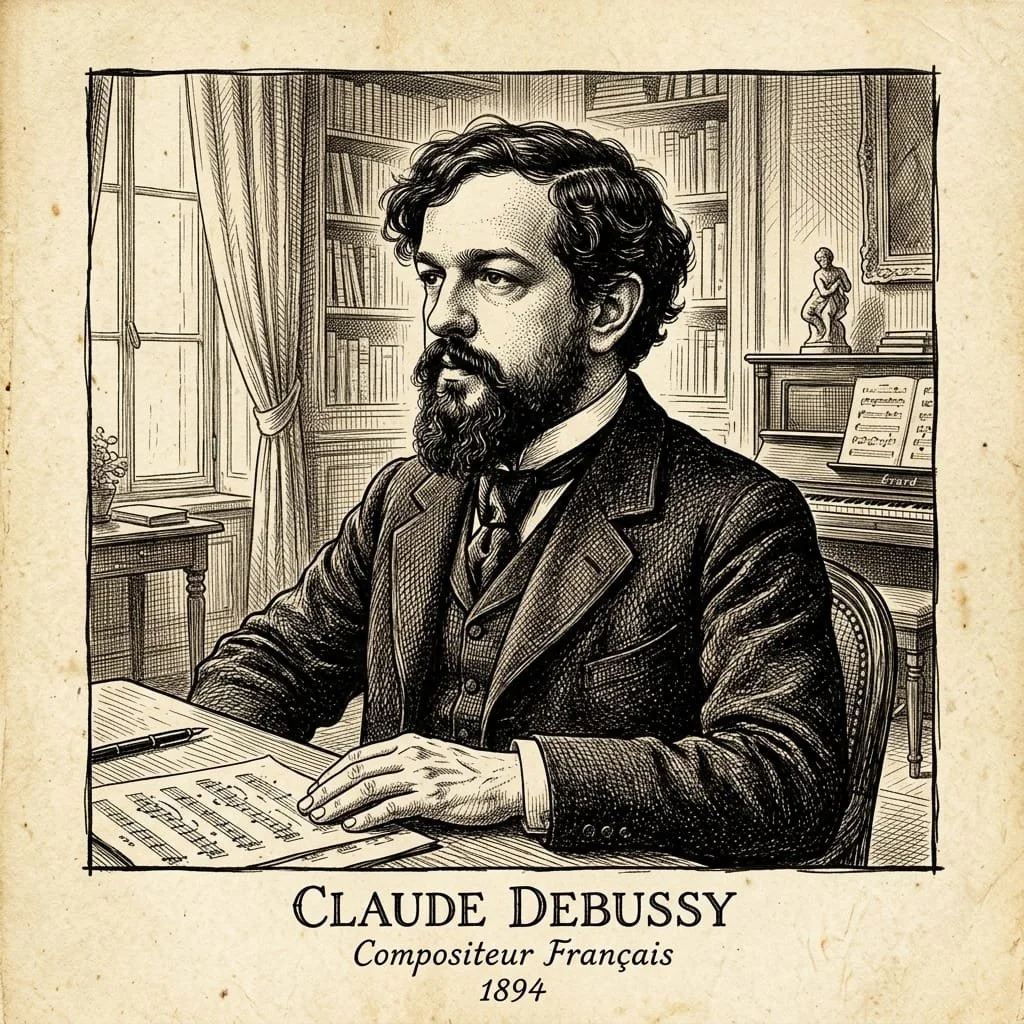
Claude Debussy was born in 1862 in Saint-Germain-en-Laye, just outside Paris. He entered the Conservatoire de Paris at ten years old, where he clashed constantly with his professors over his unconventional ideas. He won the Prix de Rome in 1884 — the most prestigious composition prize in France — but spent the rest of his life quietly dismantling almost everything his teachers stood for. By the 1890s, with works like Prélude à l'après-midi d'un faune and his opera Pelléas et Mélisande, Debussy had forged a sound that was unmistakably his own: shimmering, sensory, and free of the heavy structures that had defined European music for over a century. He famously called Wagner "a beautiful sunset that was mistaken for a dawn" — and then went on to prove that French music could stand on its own, not as a reaction to the German tradition, but as something entirely new. Where the Germans built cathedrals of form and development, Debussy painted in color, atmosphere, and light. He drew from places no one was looking — Javanese gamelan music he heard at the 1889 Paris Exposition, Russian composers like Mussorgsky, medieval modes — and fused them into a language that opened the door for nearly every major composer of the 20th century, from Stravinsky to Messiaen to Bartók.
His String Quartet in G minor, Op. 10, premiered in December 1893 by the Ysaÿe Quartet in Paris, is one of those works that lives in both worlds. It has the rigor of a classical quartet — four movements, cyclic themes that weave through the entire piece — but it sounds like nothing that came before it. The harmonies shimmer and drift. The rhythms breathe. It was met with mixed reactions at the time, and even his close friend Ernest Chausson had reservations. But it endured, and today it stands as one of the most important chamber works ever written — proof that Debussy could work within tradition and still blow the walls off it.